AI webinar series: AI overview June 2026
Explore our AI webinar, covering the essentials of AI, its importance, applications, and how to prepare your business for this transformative...
7 min read
Building an "AI context" is a concept that isn't widely known, but it's a really important one to grasp because getting it right will greatly improve the output you get from AI. It will also save your team significant time by no longer needing to repeat context for every prompt you write.
Context is everything that you already know that an AI doesn't.
Think about it this way, when you ask an AI to do something, you write a prompt. A prompt tells the AI what to do—it's the instruction (if you want to learn how to write great prompts, take a look at our blog about using prompt frameworks). The context, however, tells the AI the background information and constraints that shape how the task should be completed.
Without proper context, even the most precisely worded prompt will produce generic, inconsistent outputs that may not align with your business standards. Context is what transforms AI into a tailored assistant that understands your business environment, communicates in your voice, and operates within your guidelines. Microsoft and Anthropic have both published documentation that backs up this approach; Comprehensive context creates outputs that require less revision and better reflect their business requirements. Even Gartner has been getting in on the action.
Context for AI really has two levels that you need to think about: Business Context and Personal Context. Both need to be fleshed out to make an AI useful. Let's explore what the difference is.
The drawbacks of working without a shared source of business context quickly become obvious when they're pointed out, but it's something many business owners haven't thought of yet. Every employee ends up repeatedly explaining the same information to AI tools, wasting time and effort across the organisation.
It also leads to inconsistency. Different people will provide different levels of detail, use different terminology, or describe the same process in different ways. The result is AI-generated content that varies from person to person, whether that's customer emails, marketing materials, proposals or internal documents.
As the business grows, information will undoubtedly become fragmented, teams may create their own versions of FAQs, service descriptions or standard responses. This contradictory and disparate landscape of data will confuse an AI (not to mention new staff).
Whilst much discussion around AI adoption focuses on productivity gains, context serves an equally important function as a governance and risk management tool. For businesses operating in regulated sectors particularly, this aspect of AI context deserves careful attention.
Documented context establishes approved parameters that reduce the likelihood of AI producing inappropriate or non-compliant outputs. This includes embedding approved terminology that reflects your brand positioning and avoids language that could create legal exposure. Regulatory requirements relevant to your industry can be incorporated, helping AI-generated content be to compliance standards, reducing the amount of rework required.
Legal disclaimers, internal policies, and operational procedures all benefit from contextual embedding. The more precisely these parameters are documented and made available to AI systems, the lower your risk exposure. This is particularly relevant for small businesses where a single compliance failure or brand misalignment can have disproportionate consequences.
The above said, ALWAYS check the output of AI. Context improves the quality and consistency of AI outputs, but it should sit alongside human review, data governance, access controls and clear AI usage policies. It is not infallible, far from it.
One final thought on the consequences of not building out context. When someone leaves your business, the knowledge they have in their heads goes with them leaving the next person to make up their own. A shared business context means a continuity of data in your organisation. That in itself makes this process worthwhile.
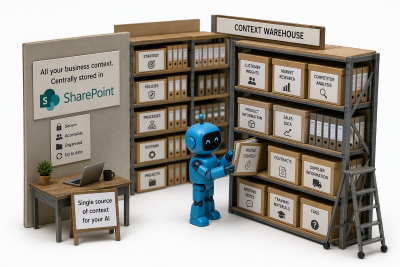 Business context forms the foundation of how AI understands and represents your organisation. It's the baseline that's applied by AI regardless of who is using it in your organisation. Here we are talking about your broad organisational parameters such as your tone of voice, brand guidelines, policies, regulatory requirements, and operational guardrails.
A good analogy would be thinking about a really skilled contractor coming into your business. Before you set them off working, you need to give them an induction, tell them all about your company and how you operate. The same goes for AI.
Whilst business context addresses organisational standards, personal context tailors AI output to individual people. It helps the AI respond as you would, and it will help it keep responses to queries and requests aligned with your specific requirements for your role.
Personal context includes information about an individual's role, specific responsibilities, communication preferences, and working style.
For example if a sales manager and a customer account manager give an AI the same prompt:
"draft a follow-up email after the meeting with Customer Ltd about adopting Microsoft Copilot"
The sales manager's personal context tells the AI that they are measured on generating new opportunities and growing revenue.
The customer success manager's personal context tells the AI that they are measured on customer retention and adoption of platforms.
With these two different contexts the AI might reply to the sales manager's query with an email that focuses on business value, booking a follow-up discovery session, including a call-to-action, and highlighting potential ROI and productivity gains. The customer success manager'ail might instead focus on agreed actions, adoption milestones, training recommendations, and next steps to help users get value from Copilot.
An important consideration that many won't have thought about is where to store and maintain AI context. You have two options.
The first approach involves building context directly within AI tools using built-in memory and remember functions. Microsoft Copilot and other AI platforms offer native capabilities to store preferences and contextual information within the application itself. This approach provides immediate integration and requires no external document management.
However, the second approach—storing context in structured documents within shared locations that AI tools can access—offers significant advantages. This method creates a centralised repository of organisational knowledge. When your business context exists as accessible documents, you can instruct any AI tool to reference these materials, eliminating platform lock-in. If you transition from one AI service to another, or use multiple AI tools simultaneously, each can access the same authoritative context source.
In addition, document-based context storage simplifies maintenance. When your business changes its guidelines or policies, you only need to update a single document rather than reconfiguring multiple AI platforms or individual user settings. This becomes particularly valuable as your team grows—new employees can be granted access to established context documents, ensuring immediate consistency without requiring individual setup for each team member and each AI tool they use.
So our recommendation is build out a library of word documents and store them in a controlled SharePoint or Teams location, make sure the right people have access, and encourage users to reference the relevant context documents when asking AI to complete business tasks. It's worth having users tell the AI to 'Remember' to always reference them but don't rely on it alone. Memory features vary between tools and are not a foolproof way to ensure the AI always uses your context.
Establishing clear business context ensures that AI tools understand the professional standards you've set for your employees. This includes defining your preferred terminology—whether you use specific industry terms or avoid certain language—your communication style, and any compliance requirements relevant to your sector.
Business context also establishes the boundaries within which AI should operate. This includes your quality standards, customer service approaches, and any legal or regulatory constraints that must be consistently applied. By documenting these parameters once and making them available to your AI tools, you ensure that every interaction maintains professional consistency and meets your organisational standards.
We recommend creating the following suite of documents with appropriate headings and subheadings to help the AI understand how everything fits together. They can be written in plain English and even just use bullet points to simplify the writing for you.
Why it matters: The AI can then suggest actions that align with how the business actually operates
Remember to review your business context regularly, and update it. Stale information is unhelpful to staff and AIs alike.
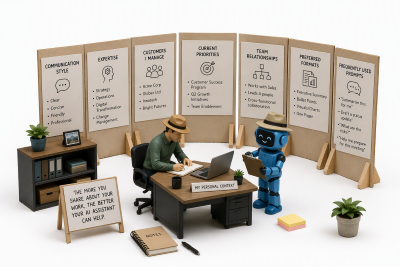 Creating your personal context should be significantly easier. Again you can create this directly in an AI using the Remember command but we'd suggest storing your personal context in a Word document stored in OneDrive and just point an AI at it.
Personal context will vary for every person so there's no easy checklist that we can provide you but some of the basics you might want to consider are:
Your title and role summary (maybe put your full job description in if you have it documented)
your decision-making authority
your preferred communication format (formal reports versus concise summaries)
stylistic preferences such as whether you use emojis in internal communications or prefer strictly professional language.
Your working hours and patterns (typical meeting schedule etc)
details of recurring tasks that you do, or specific workflows you follow.
When AI understands these personal parameters, it can provide more relevant suggestions, prioritise information more effectively, and generate outputs that require minimal adjustment before use.
If you're looking for assistance with implementing, or improving your use of AI in your business then get in touch with us. Our Edinburgh-based team provide AI consultancy across Scotland and northern England.

Explore our AI webinar, covering the essentials of AI, its importance, applications, and how to prepare your business for this transformative...
Learn how to effectively roll out AI in your business with our practical 90-day plan, ensuring consistent adoption and maximising value from the...

Businesses that fail to prepare for AI integration risk falling behind competitors by up to 40% in operational efficiency within the next two years.